Political Organization of Space
Territorial Dimensions of Politics
The Concept of Territoriality
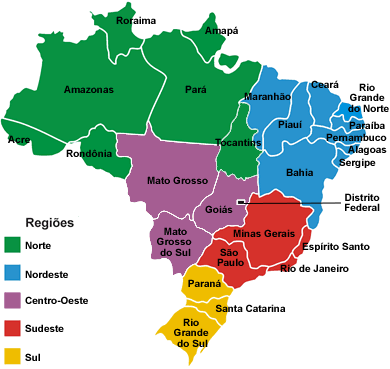
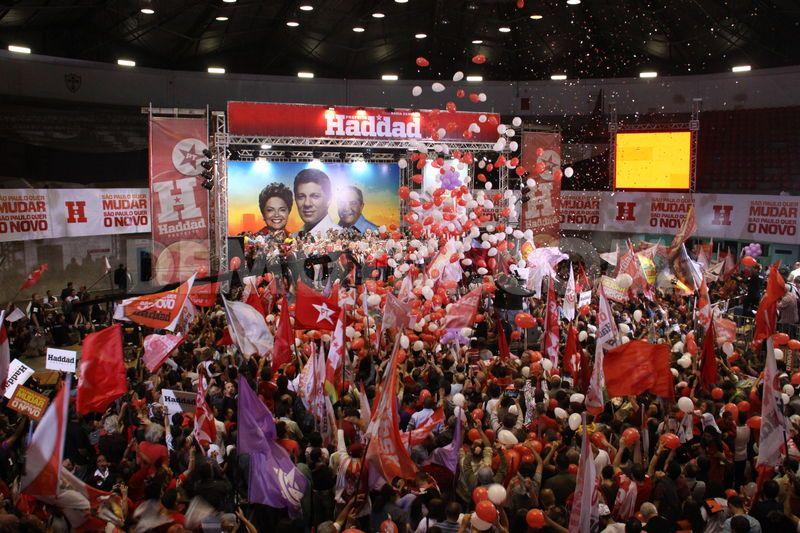
Brazil has 26 states, each of which is self governing and responsible for their own finances, including taxes (although the federal government can also administer taxes). The person leading the executive branch is called the Governor, and each governor must run for their position every four years. Brazil has 28 different recognized political groups, although not all of them are usually elected. The federal government is centered in Brazilia as well as a few other cities, each of which have a regional administer, and are, as a whole, represented by a governor.
The Significance of Boundaries
Evolution of the Contemporary Political Pattern
The Nation State Concept
Brazil is considered to be a nation state. While many different lifestyles are all within Brazil, there is a general consensus that there is a defined feeling of an overall general culture (Brazilian Culture can be found on the Population and Culture page). This is a mixture of Portuguese (the original settlers), African (because of Brazil's background in slavery) and native culture.- The United States
- Canada
- China
- India
- All of the members of Mercosur (including Argentina, Paraguay, Uruguay, and Venezuela)
- Bolivia, Chile, Colombia, Peru, and Ecuador
- Russia
Agricultural and Rural Land Use
Variations Within Major Zones and Effects of Market
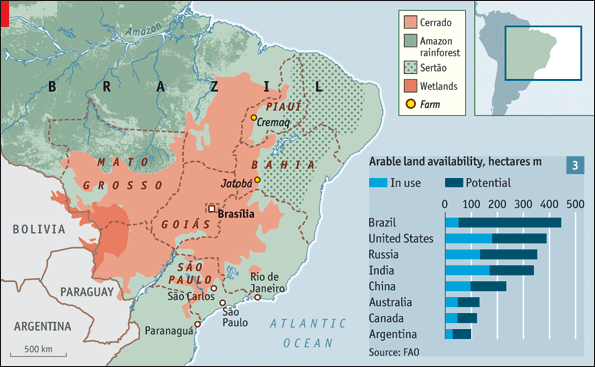
The Cerrado of Brazil has been put to use, and is where the majority of farming occurs. The Amazon Rainforest, and the Sertao are available for use, and are a huge asset for years to come. Farming still tends to revolve around southern Brazil where the population is so much more dense and the more fertile soil of the Cerrado is located. And while huge companies are more efficient, small farms help employment rates. Most goods are grown in the south because exportation is then easier, and farmers now have the technology to farm the savanna soils, which have higher nutrient levels. Brazil's market is much better because of this, and the country has become one of the largest exporters of food in the world.
Source for Photos: http://www.economist.com/node/16886442
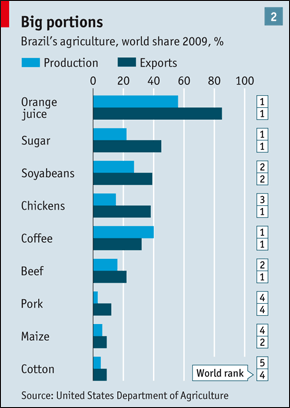 | Linkages and Flows Among Regions of Food Production and Consumption While Brazil has huge potential, the country is also becoming limited by growing consumption rates as Brazil begins to have more of a middle class. Major farms are located in the South, where the majority of the population resides, and this is obviously both because of easy exportation and higher in-country demand. |
Rural Land Use and Settlement Patterns
Settlement Patterns Associated with Major Agriculture Types
Settlement in Brazil has been focused in the south for several reasons. While the northern area was actually the first place settled, this was due to the more abundant goods and easy soil access. The cerradoes were not farmed, but used sparingly for the light traffic to the south. Then gold and diamonds were found in the late 17th and early 18th centuries, and plantation owners moved south in search of wealth. Beautiful cities were constructed, roads south were built, and the central government was eventually transferred to Rio de Janeiro in 1729. Wealth was also attracting immigrants from Europe, and coffee plantations brought even more money to the then-colony.
Modern Commercial Agriculture: The Third Agricultural Revolution
The Green Revolution and the Beginning of the Biotechnologic Revolution
Brazil is currently in the middle of it's green revolution. Monoculture is becoming quite popular, because it is so good for the global economy. The environment, however, is taking a hit. Pollution is growing rapidly, and many more chemicals and pesticides must be used. The Cerrado is loosing much of its biodiversity due to growing only one thing in a particular area, and much of the food being produced does not stay within the country.
Characteristics of the Third Agricultural Revolution
Monoculture, or the planting of only one type of crop year after year, has defined the third agricultural revolution. With this, many chemicals and pesticides must be used to make sure that the crop will grow efficiently. It makes profits as high as possible, and can sometimes lead to higher production rates. The disadvantages of this are that if the crop is not protected from a particular disease or insect, it can be completely destroyed, and that the soil looses much of its nutrients.
Diffusion of Industrial Agriculture
Agriculture occurs in the southern and central parts of Brazil, because this is where the majority of the population, and where the Cerrado, is located. This means that a larger work force is available, that exports are easier to manage, and that the food is closer to where the demand is.
Future Food Supplies and Environmental Impacts of Agriculture
Brazil is currently using very little of its agricultural land, about 12% in 2010. The country also has a huge freshwater supply, about 1/3 of all the freshwater in the world. In this way, it is predicted to become an agricultural superpower in certain products in the years to come. However, the use of land for agriculture ultimately means that the more farming that occurs, the more biodiversity will be lost.

