Population
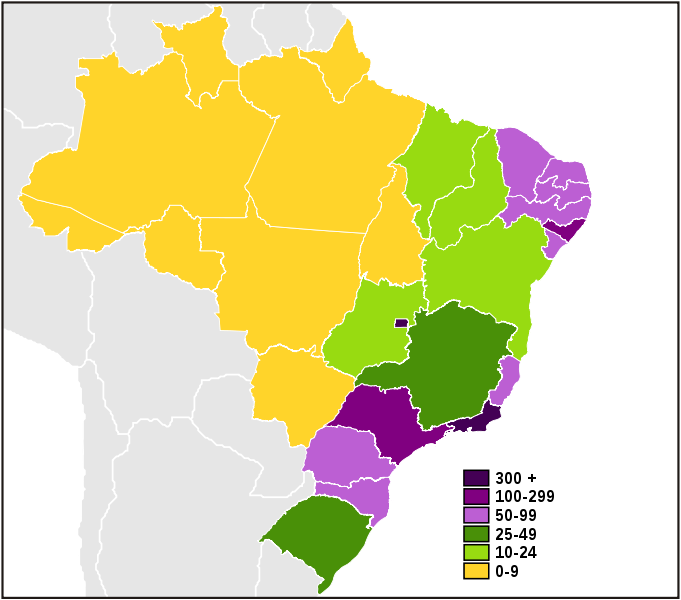
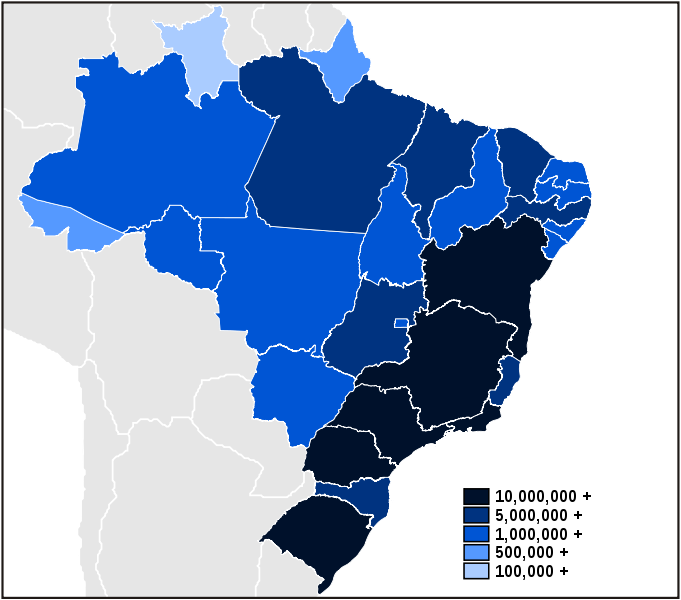
The projected population size of Brazil in July of 2012 was approximately 206,000,000, making it the fifth most populated country in the world. There are 23 people per square kilometer. The population growth rate is at approximately 1%.
87% of Brazil's population resides in urban areas. The rate of urbanization is at 1.1%.
Largest Cities
This list includes the population of the city's metropolitan area.
São Paulo is Brazil's most populated city, with approximately 20 million people.
The second largest city is Rio de Janeiro, with a population of approximately 11.8 million people.
Third is Belo Horizonte, with a population of 5.7 million.
Fourth is Porto Alegre, with a population of 4.03 million.
Brazil's capital, Brazilia, has a population of approximately 3.7 million, making it the fifth largest city in Brazil.
Problems with Urbanization
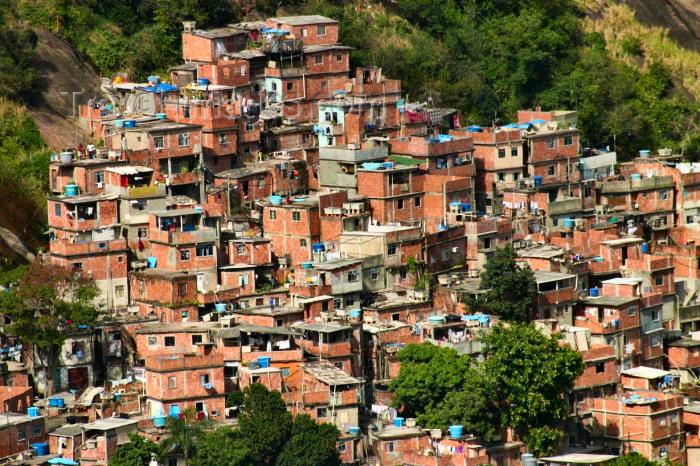
In large cities such as São Paulo and Rio de Janeiro, urbanization has become a problem. Many migrants have chosen to live in these cities in search of work, but there is no place to live. This has resulted in large, impoverished communities on the outskirts of the city, where citizens will construct their own homes out of scrap materials such as wood and metal. Overcrowding is very common, and the conditions are highly unsanitary due to lack of plumbing and waste management.
Composition
Gender
Brazil's population is most highly concentrated in people between the ages of 15-64 years old, sitting at 67%. 26.2% of the population is younger than this, and 6.7% of the population is older. Male populations are slightly higher than female in the youngest group, while female populations are slightly higher when looking at people over the age of 14. Overall, however, the sex ratio sits at 0.98 males/1 female. The average median age between males and females is 29.4. The median age just for males, however, sits at 28.5 years old, while females is at 30.1. The fertility rate is at 2.4 children/1 woman.
Religion
Like the rest of South America, Brazil's major religion is Roman Catholic, at 73.6%. Unlike the rest of South America, however, they have a higher rate of other religions, including Protestant (15.4%), Spiritualist (1.3%), and Bantu/Voodoo (0.3%). The remaining percentage are either extremely low, or unspecified.
Ethnicity
The largest ethnic group in Brazil is white, at 53.7%. Other prominent races in the country include mulatto (mixed black/white) 38.5%, and black, 6.2%. Other races stand at 0.9%, and 0.7% of the population is unspecified.
Population and Natural Hazards
Flooding
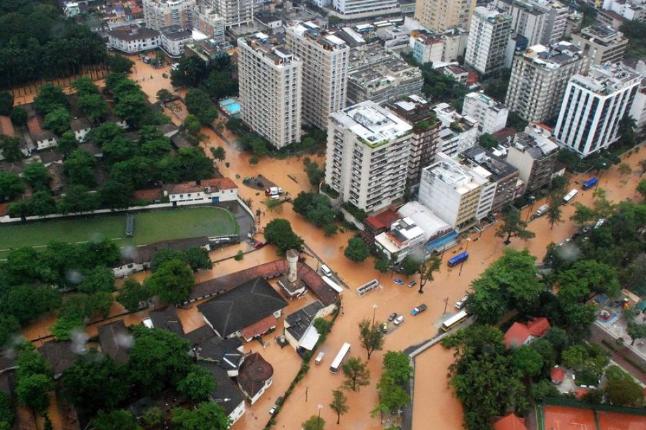
Flooding is perhaps Brazil's most common natural disaster. While flooding is not necessarily a new occurrence, the damages inflicted and the severity of the floods has become increasingly worse over the years. Between 2008 and 2011, five major floods have impacted places of large population density, three of which occurred in Rio de Janeiro. Northeastern Brazil and Santa Catarina were the other areas affected. Flooding in Brazil has caused millions of dollars in damages, and hundreds of deaths. With high population density areas like Rio de Janeiro, the affects become magnified. Not only do floods create damage on their own, but they also cause large landslides, which are often just as deadly.
Landslides
Landslides occur mainly during flooding, in mountainous areas. This poses a problems for some of Brazil's cities, which are located in places with steep slopes.
Population Growth and Decline
Brazil, like the rest of the world, has had a rapidly growing population over the past two centuries. While the growth rate now stands at approximately 1%, the country's population is expect to have grown to about 230,000,000 by 2050, according to the U.S. Census Bureau.
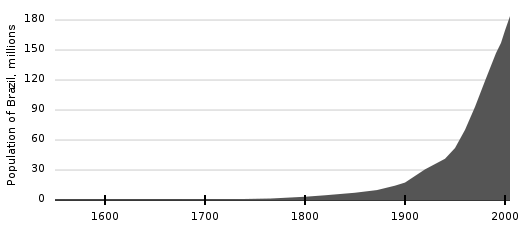
Population growth is predicted to stabilize in 2050, with no increases or decreases. Population growth peaked in the 1960s at 2.9%, and the rate has continued to decrease from there. Brazil has historically had a high growth rate. The country's rate of growth sat at over two percent between 1870 and 1986.
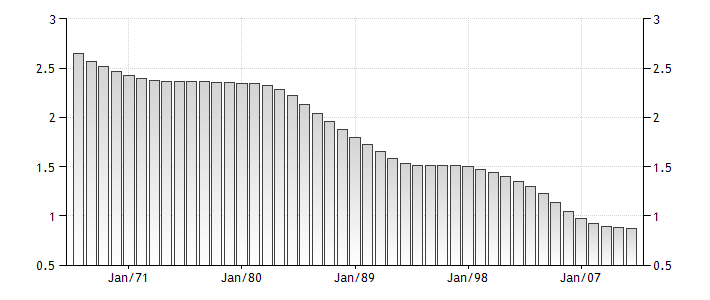
Key: Numbers listed on the vertical axis represent the population's growth rate in percentage. The horizontal axis shows month and year. This graph spans from 1967 to 2012. |
Fertility, Mortality and Health
Fertility Rate
Brazil's Fertility rate has gone up and down over the past decade, with the average of a 2.04 TFR (Total Fertility rate), meaning that if all children were evenly distributed among woman, every woman would have 2.04 children. 2012 has a lower fertility rate than any of the past twelve years at 1.82, perhaps predicting a trend.
Photo Source: http://www.indexmundi.com/g/g.aspx?c=br&v=31
Mortality Rate
Brazil's Infant Mortality Rate has been decreasing substantially throughout recent years, however, it remains high in comparison to other countries. In 2012, the infant mortality rate sat at 20.5 deaths per 1000 births, the 94th highest in the world. Mortality rates are actually lower in Vietnam and Libya. Brazil's Infant Mortality Rate may also be inaccurate, because it is difficult for citizens in poverty or living in rural areas to register for a death certificate, because it is both expensive and difficult to acquire. Below is a graph showing the decrease throughout recent years.
Photo Source: http://www.indexmundi.com/g/g.aspx?c=br&v=29
Death Rate
Brazil has a death rate of 6.38 deaths per 1000 people, making it neither extremely low or high in comparison to other countries. It is ranked at 151st highest, in between Tajikistan (150th) and Iceland (152nd).
Photo Source: http://www.indexmundi.com/g/g.aspx?c=br&v=26
Regional Differences Northern Region Acre, Amazonas, Roraima, Para, Ampa, Rondonia, and Tocantins. As of 2010,15,864,454 citizens inhabited the northern region of Brazil. Para is the most populated of the federal states, with over 7 million citizens. Most of the population lives in moderately sized cities, as much of the land (especially in the Amazonas) is trying to be preserved. In the 1960s and 70s, the government offered incentives to people who wished to settle the land and farm it. In 1989, however, all incentives were suspended. Northeast Region Maranhão, Piauí, Ceará , Rio Grande do Norte, Paraíba, Pernambuco, Alagoas, Sergipe, and Bohia. This region holds approximately 30 percent of Brazil's total population. Oil fields in this region are prosperous, among other resources, and its economic possibilities have attracted a large population, despite the droughts that occur here. Central-West Mato Grosso, Goiás, Mato Grosso do Sul, and Brasilia. This region has not attracted much in the way for population, with the exception of Brasilia, the Brazil's capital. With lots of grasslands, it is the ideal place for farming. Southeast Minas Gerais, Espírito Santo, Rio de Janeiro, and São Paulo. This part of Brazil is highly urbanized and industrialized, and its economy has attracted the majority of the population. Farming is also most advanced in this region. South Parana, Santa Catariná, and Rio Grande do Sul. A combination of the Southeast and the Central-West, this region is developed, and is known for manufacturing hydroelectricity. | 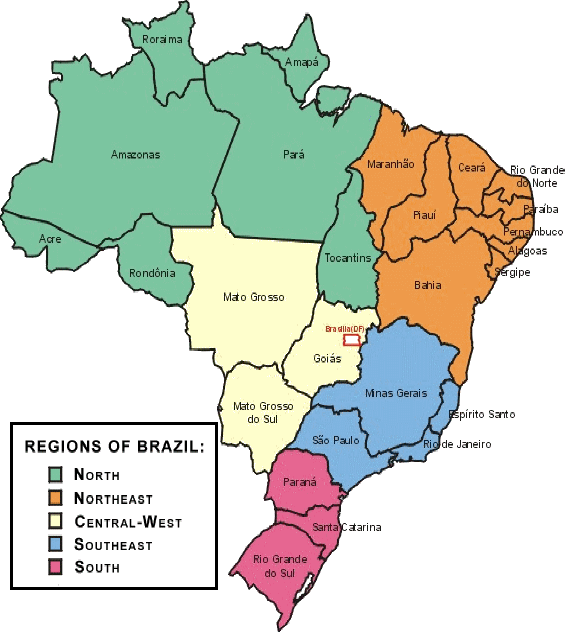 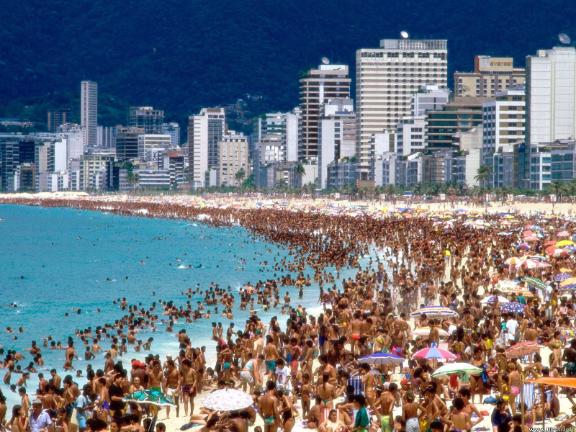 Rio de Janeiro Photo Source: http://www.hiren.info/desktop-wallpapers/other-mix-pictures/sea-of-humanity_rio-de-janeiro_brazil |
Population Policies
In order to limit population growth, many policies offering contraceptives to woman of almost any income have been put in place. This has helped somewhat. Another program, this one created by those in the medical field, called BEMFAM (the Brazilian Society of Family Welfare), was put in place to help those in poverty plan their families, and get them the required medical treatment. Services are provided through preexisting hospitals, which would offer healthcare that some families would not otherwise be able to afford. Now, the government has begun offering services, which are not fully developed and are not very helpful.
Population Movement
Many people are attracted to Brazil because of it's climate and atmosphere. It is hot and sunny, and is home to many sociable people. Culture is abundant, with carnivals and festivals held regularly. However, despite the fact that the country has a large economy, making money is very difficult. 26% of the population is under the poverty line, and the average per capita GPD is at $11,600 US dollars. Social and racial prejudices are abundant, and the public security system can be unreliable. Crime rates are very high, especially related to drugs, and the police force is often corrupted, resulting in ignored crimes. A recent arrest of over 63 police officers was the result of bribery. You can see the full story here: http://www.cnn.com/2012/12/04/world/americas/brazil-police-arrested/index.html
Most of Brazil's population movement is based on economic factors. With a high poverty rate, people will be pulled to almost any place at almost any cost if work is available. Examples of this include the migration to Minas Gerais in search of gold and diamond in the 17th century, and high urbanization rates in large cities in the 1960s and 70s. Large cities now have very few available jobs, and so the population now moves toward moderately sizes cities where jobs are more abundant.
Culture
The Concept of Culture
Culture Traits
Brazil is a diverse country, with many different ethnicities in populating the country. Despite this, the country has a prominent class system and racial prejudices are prominent. The richer parts of the country, in the South, tend to look down upon the rest of the country deprecatingly. Family is important in Brazil, and are often both large and close. Employing your own family is common and is not frowned upon in Brazil. Portuguese is the commonly spoken language in Brazil, which is the only country in South America who speaks the language. Rio de Janeiro is considered the cultural hub, and includes many world renowned festivals (including Carnival, a holiday celebrated extravagantly), and beautiful landmarks, such as beaches and the Christ the Redeemer statue.
Cultural Diffusion
The most commonly recognized concept of cultural diffusion in Brazil is their language, Portuguese. Nearly 100% of the population is fluent in the language, although there are not any other counties in South America that use it. Roman Catholicism is another example of cultural diffusion. While the religion did not originate there, 73% of the Brazilian population identify themselves as Catholics. The belief was introduced through missionaries from Europe in the 15th century. Much of the culture has African influence (due to the high number of slaves brought to the country in the 17th, 18th, and 19th centuries), European influence (those who began settling Brazil in the 15th century), and native influence (native peoples who crossed Beringia and originally settled Brazil).
Acculturation
Acculturation is only really prominent in Brazil for the minority populations. Native people have significant difficulty living their traditional way of life in a country that is trying to stay as one of the major economical forces in the world. Brazil is, however, home to many untouched tribes that have never been contacted.
Cultural Regions
Brazil has two regions that are most identified by the population: the North and the South. Those who live in the southern part of Brazil tend to have a higher income, and dwell in the city. They believe that they are more sophisticated than those who live in the northern part of the country, who they attribute to ruining their country. Northern citizens are usually lower income, and are not always given the same opportunities for education and healthcare. They may travel south to find work, where they are often shunned.
Cultural Differences
Language
Brazilians are fluent in Portuguese, unlike the rest of South America. Native languages are spoken by the indigenous peoples, but it is a minority language.
Religion
Over 70% of the citizens of Brazil identify themselves as Roman Catholics, however, only around 20% actually attend church regularly. The reason for this begins with the origins of the country, when there was no freedom of religion. Protestant and The Church of Jesus Christ of Latter-day Saints are the second and third largest religions in the country.
Ethnicity
Approximately 53% of Brazilians are white, around 35% are mixed race, and about 6% are black. Despite the fact that very few Brazilians admit to having any sort of racial prejudice, almost all of them agree that the country does suffer from it.
Gender
Gender roles are more emphasized in Brazil than in the U.S. If while in Brazil, you were to ignore gender differences, you would be considered offensive. Women are generally expected to care for the home, while men are the primary providers for the family. Income and racial differences can also change the way in which certain genders are expected to behave. If a woman is both white and has a high income, she will have more freedom to behave as she chooses than if she was colored with low income. Even so, a woman's value is placed primarily on her beauty, making Brazil the plastic surgery capital of the world.
Popular and Folk Culture
While sports such as volleyball are quite popular in Brazil, soccer is culturally very prominent. Nearly everyone in Brazil is a fan, and they hold extreme pride over it. Because of this, it is important to be wary when telling Brazilians your favorite team.
Beaches are a popular place to go to relax during the day. They are often extremely crowded, and full of street vendors. At night, parties are often underway. They normally do not start before midnight, and most Brazilians will not show up on time anyway.
Music is also a large part of Brazilian culture. The samba is the most recognized, as both a music style and a type of dance. Pop music is the second most culturally prominent.
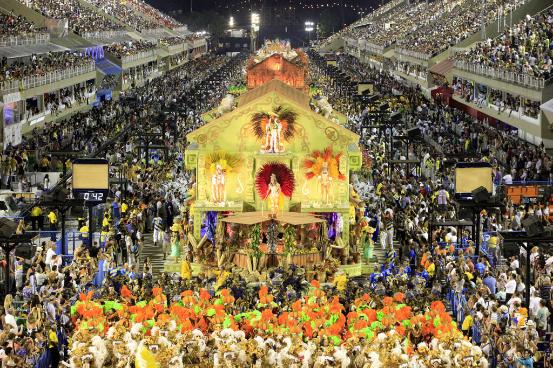 Photo Source:
http://gobrazil.about.com/od/riodejaneiro/ss/riotravelguide_8.htm
| Carnival is Brazil's yearly celebration of freedom and happiness. While it is recognized all around the country, Rio de Janeiro is known for the most spectacular sights. It is held 40 days before Easter, right at the beginning of Lent. Months of preparation are put into the festival, and participants are often enrolled in samba classes so that they can learn their routine. Street parties are held all over the city, and the main event is held in a large stadium, where seats are expensive and can be difficult to acquire if not purchased in advance. There is no real specific purpose of Carnival, it simply lets social and racial boundaries be forgotten for the duration of the three days it takes place. |
Environmental Impact of Cultural Attitudes and Practices
Brazil's main environmental problem is the ruining of untouched land, including the Amazon Rain Forest, for agriculture. The main reason for this is the big profits that can be made by large corporations, which usually control the majority of the land. This problem has been addressed, however, and a vast part of the land has been preserved. While Brazil's new leader does not seem to appreciate this problem as much as others, and care is declining, progress has still been made. The average Brazilian, however, does not highly appreciate the environment, and is usually more interested in making a profit that conservation. This is not considered bad, rather, it is culturally accepted.
Cultural Landscapes and Cultural Identity
Values and Preferences
Brazilians are known for being informal and charming. They place a high value on family, and often are encouraged by their parents to live at home for as long as possible. It is perfectly acceptable to live with your parents if you are middle aged. Brazilians also tend to avoid conflict, and usually do not put any emphasis on the common good. This relates to the way high and low income citizens treat each other.
Symbolic Landscapes and Sense of Place
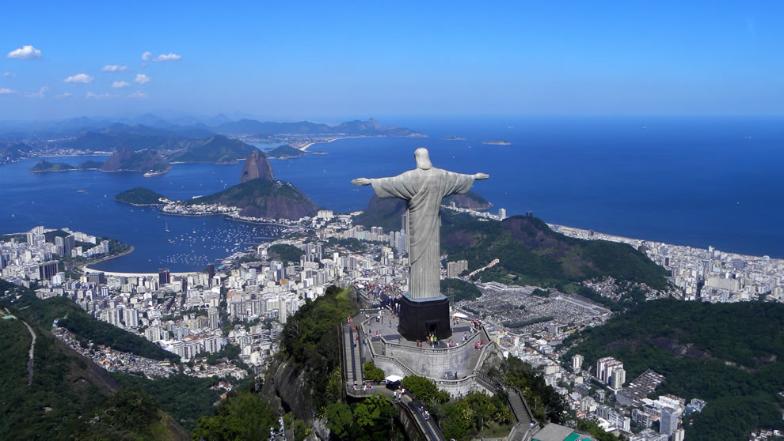
Perhaps the most internationally recognized landmark in Brazil is the Christ the Redeemer Statue. Located on top of Corcovado Mountain in Rio de Janeiro, it is 125 feet tall, and can be seen from a distance.
The southern part of Brazil is where the majority of the high income population resides. Citizens often never see any other part of their country, believing that it is simply where the poorer people live.